
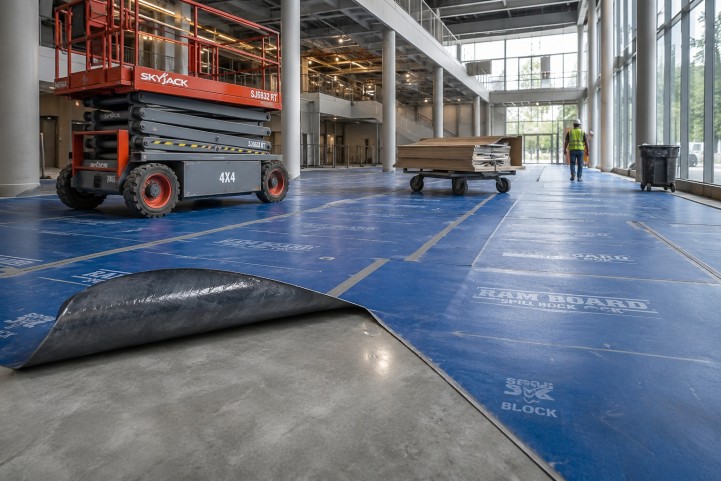
Modern higher education architecture has undergone a radical design transformation over the past decade. Academic institutions have largely moved away from the uninspiring linoleum tiles and dark carpeting of the past. Instead, today’s student unions, STEM research centers, and sprawling campus innovation hubs prioritize open, light-filled spaces featuring expansive polished concrete floors. Architects favor this minimalist, industrial look because it is highly durable, easy to sanitize, and perfectly reflects a contemporary, forward-thinking learning environment.
However, choosing a decorative concrete finish creates a unique set of logistical challenges for the build team. When a floor is intended to be both the structural foundation and the final aesthetic showcase, the raw slab must be treated with absolute precision from day one. Unfortunately, the rugged environment of an active, multi-trade jobsite is the exact polar opposite of a delicate design studio. If the curing concrete is subjected to unmitigated physical friction during the early stages of the build, its long-term aesthetic value can be permanently ruined long before the polishing pads ever touch the surface.
The Mechanics of Surface Bruising
To understand why raw concrete is so vulnerable, one must look at how the material achieves its signature high-gloss appearance. Polished concrete relies on a multi-step diamond grinding process that progressively removes the top micro-layer of the slab to expose the dense paste or aggregate underneath.
During the initial curing phase, however, concrete is relatively soft and highly susceptible to mechanical deformation. When heavy scissor lifts spin their tires, drywall carts haul multi-ton loads, or steel-toed boots stomp through a work area, they apply intense, localized shear stress to the unprotected surface.
This intense friction creates micro-fissures and internal fracturing within the stone matrix—a phenomenon known in the trade as “surface bruising.” While these micro-bruises may look like faint tire marks or scuffs at first, they actually run millimeters deep. When the polishing sub-contractor arrives months later to begin grinding, these fractured zones absorb chemical densifiers and stains unevenly. The result is a splotchy, marred finish with permanent dark rings or cloudy patches locked directly into the stone.
[Exposed Curing Slab]  --> Scissor Lift Tire Spin --> Deforms Soft Stone Matrix --> Permanent Clouding / Blotchy Finish
[Temporarily Adhered Mat] --> Absorbs Wheel Shear --> Distributes Weight Evenly --> Flawless, High-Gloss Aggregate
The Threat of Particle Migration and Grinding Lines
A secondary, aggressive threat to a decorative slab is the migration of ambient construction grit. A typical campus build site is a chaotic environment filled with airborne drywall dust, metallic shavings from electrical conduit cutting, and abrasive stone aggregate from exterior masonry work.
When workers walk or roll heavy machinery over a loose, unanchored covering—such as standard cardboard or plastic sheets—the grit that has inevitably snuck underneath is trapped between the protective layer and the floor. The shifting covering turns that trapped debris into an abrasive grinding medium. Under the weight of heavy carts, these particles are ground into the floor, leaving permanent micro-scratches and gouges. By the time the final cleanup occurs, the contractor is left with an expensive, unbudgeted remediation nightmare that can delay the grand opening of the building.
Architecting a Second Skin for the Substrate
Preventing these visual defects requires moving past improvised, loose-laid tarps. It demands a sophisticated defense strategy that temporarily alters the physical properties of the workspace. True surface preservation requires completely eliminating the space between the defensive barrier and the floor, ensuring that zero movement and zero grit migration can take place.
Modern construction managers achieve this by implementing high-performance, surface-adhered protective mats as soon as the concrete can support foot traffic. For high-profile, fast-tracked college construction projects, this involves rolling down a specialized, water-based liquid coating that cures into a temporary bond with the raw slab, while simultaneously pressing an industrial-grade traffic mat into the wet matrix.
This composite system acts as a literal second skin for the building’s foundation. Because it is mechanically anchored to the stone, it absorbs all the shear force from turning wheels and heavy impacts, completely distributing the weight to prevent surface bruising. Any dropped tools or wet paint spills are safely captured within the top layers of the mat, isolating the delicate pores of the curing concrete from environmental degradation while still allowing the slab to vent its internal moisture evenly.
The Economics of Campus Handovers
In the current academic sector, delivery timelines are unforgiving. Universities schedule their grand openings around tight academic calendars, meaning a delay of even a single week can throw off a full semester of enrollment, housing, and research activities. A general contractor cannot afford to lose their profit margin at the end of a project because a sub-trade scratched a custom-poured student center lobby.
By investing in advanced, peel-away defensive shielding, forward-thinking builders ensure that their hard work is preserved throughout the entire construction lifecycle. When the temporary mat is finally peeled up before the final handover, it reveals a pristine, unblemished concrete matrix that is perfectly ready for the polishing phase. Protecting the floor isn’t just about saving materials; it is an essential act of foresight that ensures the architectural center of the campus shines exactly as the university intended.
