
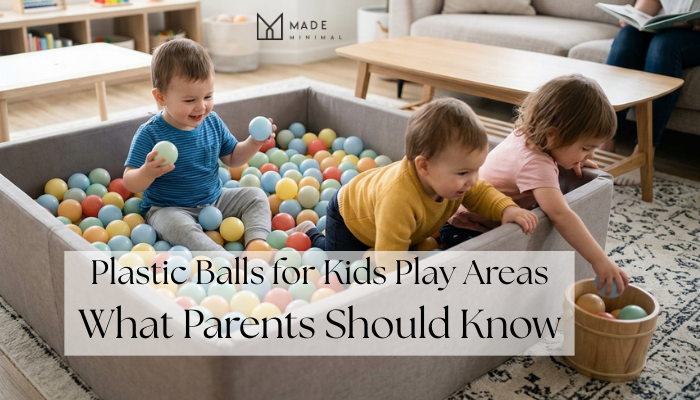
If you’ve ever searched for kids’ ball pit balls online, you already know how crowded the results are. Bags of 50 or 500, every colour you can think of, and almost no detail about what the balls are made from.
That confusion is exactly why we put this guide together. At Made Minimal, we sell play balls and toys for kids of all ages, and we check every product against Australian safety standards before it hits our shop.
And based on what we’ve seen, ball pit balls can absolutely be safe for children. But only when you know what the label should show, like BPA-free materials, correct sizing, and non-toxic paints. This guide covers how to check all of that. Including ball pit setups, cleaning, and which ages suit different types of play.
How to Pick the Right Plastic Balls for Your Setup
When you’re picking plastic balls for a play area, three things will guide your decision: size, colour, and how many you need.
Typically, size is the one thing parents ask us about most in our Brisbane showroom, and for good reason. Balls smaller than 6.5cm can be a choking risk for toddlers, so for kids under three, that’s the minimum diameter to keep in mind.
Also, when it comes to materials, look for products that meet ACCC Product Safety guidelines for children’s toys, including BPA-free and non-toxic plastic.
Here’s a quick comparison to help you sort through the options.
| Feature | What to Look For |
| Size | 6.5cm or larger for children under 3 |
| Material | BPA-free, non-toxic, crush-proof plastic |
| Colours | Single-colour sets for a minimal look, mixed packs for fun |
| Quantity | 200-500 balls for most home ball pit setups |
Once you’ve picked a size and material, quantity is the next thing to figure out. For most homes, 200 balls feel like barely anything once they’re in the pit. Around 400 is where it starts to feel right, so if you’re buying in bags of 50, plan on picking up a few sets.
And then there’s colour, which is more of a personal call. Some parents go with soft, muted tones that sit well in a living room. Others grab bright mixed packs because kids love the variety.
Now that you’ve picked the right balls, the next step is setting up a play area that works for your home.
Setting Up a Ball Pit at Home (What You Actually Need)
Frankly, you don’t need a full playroom or a big budget for this. A small corner, the right base, and a flat surface are enough to get started.

The whole setup really depends on two choices:
Picking a Base
The base you choose decides how your kids use the ball pit. For example, soft-sided fabric pits are the most popular option for indoor play, and they fold flat when you’re done.
Inflatable pools work well, too, especially if you want something easy to move around. Foam enclosures are another solid pick for toddlers because the walls hold their shape and give younger children something to lean against.
Most of the setups we’ve seen customers put together at home use either a foam pit or a soft-sided enclosure, and both do the job well.
Choosing the Right Spot
Picking the right spot is the easy part. You want a flat surface away from furniture edges and hard corners. In most homes, a living room corner or a section of the playroom works well for kids of all ages.
If you have toddlers under three, it’s also worth checking that your ball pit toys meet Australia’s mandatory toy standard for children under 36 months. This standard sets out sizing and safety requirements specifically for that age group.
You don’t even need a dedicated playroom for this. Believe it or not, most families we talk to in Brisbane end up putting the ball pit next to the couch, and it usually works just fine.
Play Balls, Active Play, and How Kids Build Motor Skills
Play balls keep kids busy, sure. But they also support real physical and cognitive development, even during what looks like simple fun.

There are three ways kids develop during ball pit play without even trying:
- Throwing and Grabbing: Every time a toddler picks up a ball, throws it, or scoops a handful out of the pit, they build fine motor skills (grip strength, hand control, and basic coordination all at once). These are the same skills children need later for writing, drawing, and using toys with small parts.
- Crawling and Climbing: When kids crawl through a ball pit or climb over the sides, they work their core muscles and improve balance. Active play like this helps toddlers develop gross motor skills that carry over into running, jumping, and other physical activities.
- Sorting and Counting: Colour sorting and counting games add an early learning angle to ball pit time. A child who sorts balls by colour or counts them into a pile is building memory and imagination skills without even realising it.
The fun part is that none of this feels like learning to them. It just feels like play, and that’s exactly why a ball pit works so well for kids of all ages.
Finding the Right Play Balls for Your Home
With safety, setup, and cleaning covered, the last step is picking the right play balls for your space. If you’ve followed the checks in this guide, you already know what to look for.
For kids, ball pit balls that are safe, soft, and built to last, Made Minimal offers a range of eco-friendly soft balls suitable for children of all ages. Every product in our toys and play range ships with free delivery Australia-wide. So you can check the details, add what you need, and have it at your door without the extra cost.
Your child might be a toddler just getting used to a ball pit, or an older kid who treats it like a daily blast of fun. Either way, a good set of play balls will keep them coming back to the pit for years.
