
Introduction
In today’s fast-moving digital world, managing content across multiple platforms has become both essential and overwhelming. Creators, marketers, and businesses are constantly searching for tools that can simplify publishing, improve consistency, and boost online visibility without requiring complex workflows. This is where platforms like Erikkapost com enter the picture, offering a centralized solution for content distribution, scheduling, and digital management.
Instead of juggling multiple social media apps, analytics dashboards, and SEO tools separately, users now prefer unified systems that bring everything under one roof. Erikkapost com is often discussed in this context as a multi-purpose platform that aims to streamline content workflows while also providing tools for optimization and performance tracking. Its concept revolves around efficiency, automation, and smarter digital presence management.
This article explores the platform in detail, breaking down its features, use cases, and benefits. Whether you are a content creator, digital marketer, or business owner, understanding how such systems work can help you improve your online strategy and stay competitive in an increasingly crowded digital landscape.
Erikkapost com Overview and Role in Digital Ecosystem
Erikkapost com is commonly described as a centralized content management and distribution platform designed to simplify how users publish and manage digital content. Instead of relying on multiple tools for scheduling, posting, and tracking, the platform brings everything together into a single dashboard. This approach helps reduce complexity and improves workflow efficiency, especially for users managing multiple online channels.
At its core, the platform represents a shift toward automation-driven content strategies. Modern digital marketing requires consistent posting across social media, blogs, and other online channels. By centralizing these activities, users can maintain a consistent brand voice and posting schedule without manually handling each platform. This is particularly useful for small businesses and independent creators who lack large marketing teams.
In the broader digital ecosystem, tools like Erikkapost com reflect a growing trend of integration. Instead of fragmented systems, users are moving toward unified solutions that combine publishing, analytics, and optimization. This not only saves time but also improves decision-making by offering a complete overview of content performance in one place.
Core Features of Modern Content Distribution Platforms
Modern content distribution systems are built around efficiency, automation, and scalability. One of the most important features is multi-channel publishing, which allows users to share content across different platforms simultaneously. This eliminates repetitive manual posting and ensures that content reaches audiences wherever they are most active.
Another key feature is analytics integration. Understanding how content performs is essential for improving engagement and refining strategies. Platforms like Erikkapost com typically provide insights such as engagement rates, reach, and audience behavior. These metrics help users adjust their content strategies in real time, leading to better results over time.
Automation also plays a critical role in modern platforms. From scheduling posts to recycling evergreen content, automation tools help users maintain a consistent presence online. This is especially important in digital marketing, where timing and consistency can significantly influence audience engagement and brand visibility.
Centralized Dashboard and Multi-Account Management
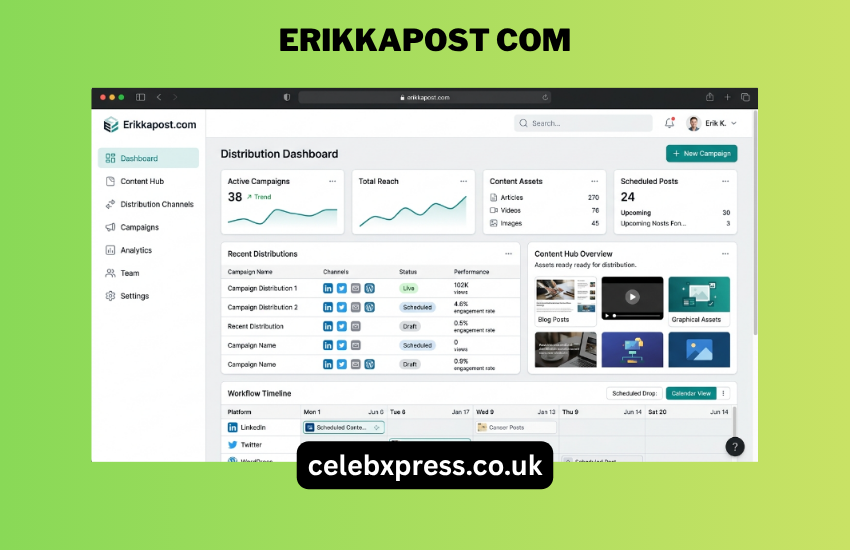
One of the most valuable aspects of a unified content system is the centralized dashboard. This feature allows users to manage multiple accounts and platforms from a single interface. Instead of logging into different social media accounts individually, users can view everything in one place, saving both time and effort.
The centralized dashboard also improves organization. Users can categorize content, track posting schedules, and monitor engagement without switching between tools. This makes it easier to maintain a structured content strategy, especially for agencies or businesses handling multiple clients or brands.
Multi-account management is particularly useful for digital marketers. It allows teams to coordinate campaigns across various platforms while maintaining consistency in messaging and branding. This reduces errors, prevents duplicated efforts, and ensures that all content aligns with the overall marketing strategy.
Content Scheduling and Automation Benefits
Content scheduling is one of the most powerful features offered by modern digital platforms. It allows users to plan posts in advance and publish them at optimal times without manual intervention. This ensures that content reaches audiences when they are most active, improving engagement and visibility.
Automation goes beyond scheduling by enabling workflows that operate with minimal human input. For example, users can set up recurring posts, automate content recycling, or trigger posts based on specific events. This helps maintain a steady flow of content even when users are not actively online.
These features are particularly beneficial for businesses that operate across different time zones or have limited resources. By automating repetitive tasks, teams can focus more on strategy, creativity, and audience engagement rather than manual posting and management.
SEO Tools and Analytics Integration in Erikkapost com
Many digital platforms now integrate SEO tools to help users improve their online visibility. In the context of Erikkapost com, these tools are often associated with keyword tracking, backlink analysis, and site performance evaluation. Such features allow users to optimize their content for search engines while maintaining consistency across channels.
SEO integration is crucial because content alone is not enough to drive traffic. Without proper optimization, even high-quality content may remain unnoticed. By analyzing keywords, competition, and ranking performance, users can refine their content strategies to target the right audience more effectively.
Analytics further enhance this process by providing real-time data on content performance. Users can track how their posts are performing across different platforms, identify trends, and adjust their strategy accordingly. This combination of SEO tools and analytics creates a powerful ecosystem for digital growth and long-term visibility.
Multi-Category Content and Publishing Strategy
A key strength of modern content platforms is their ability to support multi-category publishing. This means users are not restricted to a single niche and can publish content across various topics such as technology, lifestyle, travel, or business. This flexibility allows creators to reach broader audiences and diversify their content strategy.
Multi-category publishing also helps in audience expansion. By covering different topics, creators can attract users with varied interests, increasing engagement and reach. This is especially useful for digital publications and blogs that aim to build large, diverse readerships.
However, managing multiple content categories requires strategic planning. Without a clear structure, content can become scattered and inconsistent. Platforms like Erikkapost com aim to solve this by providing organizational tools that help users categorize, schedule, and optimize content across different themes efficiently.
Benefits for Marketers and Businesses Using Unified Platforms
For marketers and businesses, unified content platforms offer significant advantages. One of the biggest benefits is time efficiency. Instead of managing multiple tools, teams can handle everything from one dashboard, reducing complexity and improving productivity.
Another major benefit is improved consistency. Maintaining a consistent brand voice across different platforms is essential for building trust and recognition. Centralized systems help ensure that all content aligns with brand guidelines and marketing strategies.
Additionally, these platforms enhance collaboration. Teams can work together more effectively by sharing dashboards, assigning tasks, and tracking progress in real time. This improves coordination and ensures that marketing campaigns are executed smoothly and efficiently.
Future of Centralized Content Management Systems
The future of digital marketing is moving toward greater automation and integration. As online platforms continue to grow, the need for centralized systems will become even more important. Tools like Erikkapost com represent an early stage of this evolution, where multiple digital functions are combined into a single ecosystem.
Artificial intelligence is expected to play a major role in this future. AI-driven content suggestions, automated scheduling, and predictive analytics will make content management even more efficient. This will allow users to focus more on creativity and strategy rather than manual tasks.
In the long term, centralized platforms will likely become standard tools for all digital professionals. As competition increases online, the ability to manage, optimize, and distribute content efficiently will be a key factor in digital success.
Conclusion
Digital content management has evolved significantly over the past decade, shifting from manual posting to fully integrated systems that handle scheduling, analytics, and optimization. Platforms like Erikkapost com reflect this transformation by offering a centralized approach to content distribution and digital strategy management.
By combining features such as automation, SEO tools, and multi-channel publishing, these systems help creators and businesses save time, improve consistency, and enhance online visibility. As digital landscapes continue to grow, the importance of unified platforms will only increase, making them essential tools for modern marketing and content creation.
Ultimately, success in the digital world depends not just on creating content but on managing it effectively. Centralized platforms provide the structure and efficiency needed to stay competitive in an ever-changing online environment.
